
The Loneliest Generation: Why We Have Thousands of Connections but So Few Real Conversations
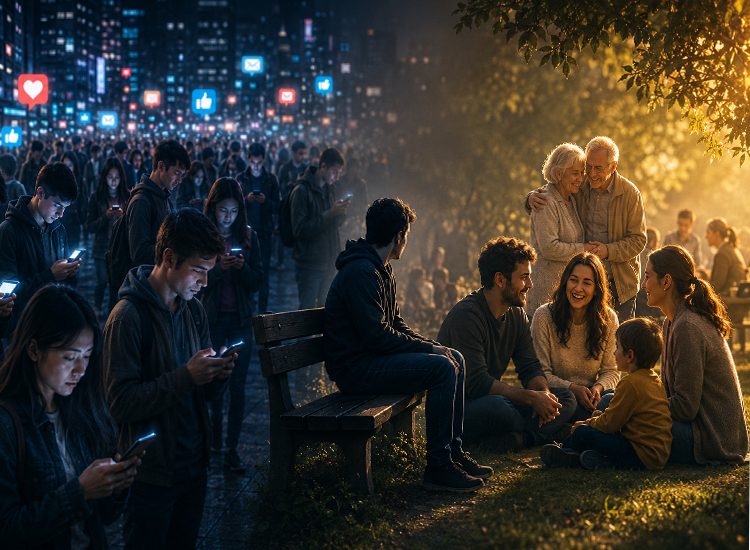
In an age where we can reach almost anyone with a single tap, loneliness has quietly become one of humanity's greatest paradoxes. We have never been more connected through technology, yet so many people have never felt more isolated.
Every day, billions of messages are exchanged across social media platforms. We react to photographs, share videos, comment on opinions, and participate in online communities. Our phones constantly remind us that someone has liked our post, viewed our story, or sent us a message. Yet, when the screen goes dark and the day comes to an end, many people find themselves surrounded by silence.
The irony is striking. We have thousands of connections but very few conversations that truly matter.
Perhaps the problem is not that we have stopped talking. The problem is that we have forgotten how to connect.
The Illusion of Being Connected
Technology has made communication incredibly easy. Families separated by continents can see each other instantly. Friends can remain in touch despite busy schedules. Businesses can collaborate across time zones.
These are remarkable achievements.
However, somewhere along the journey, convenience slowly replaced intimacy.
Today's social media often offers a false sense of connectivity. We exchange messages throughout the day, send voice notes, or even spend hours on video calls. When the conversation ends, we feel as though we have spent meaningful time together.
But something essential is still missing.
The psychological reassurance that comes from sitting beside another person cannot be transmitted through a screen. The warmth of holding someone's hand during a difficult moment, the comfort of a reassuring hug, the silent understanding conveyed by shared presence—these experiences remain uniquely human.
A video call allows us to see a face.
A real meeting allows us to feel a presence.
That difference is far greater than we often realize.
Emoticons Can Never Replace Emotions
A smiling emoji can brighten a message.
A heart emoji can express affection.
A folded hands emoji may convey gratitude.
Yet none of them can replace genuine human emotion.
A laughing emoji cannot recreate the contagious laughter shared between friends sitting around a table.
A crying emoji cannot carry the comfort of tears wiped away by someone who genuinely cares.
A red heart cannot match the reassurance of a warm embrace after months apart.
Digital expressions help us communicate, but they should never become substitutes for real emotional experiences.
Human beings evolved through relationships built on voice, touch, facial expressions, eye contact, and physical presence. These elements create trust in ways that no technology has fully replicated.
Our minds recognize authenticity beyond words.
Sometimes, the most meaningful conversation happens without speaking at all.
The Rise of Surface-Level Conversations
Modern conversations have become shorter, quicker, and increasingly transactional.
"Reached?"
"Okay."
"Fine."
"LOL."
"👍"
Communication has become efficient.
Unfortunately, meaningful relationships rarely grow through efficiency alone.
Real conversations require time.
They require curiosity.
They require listening without planning the next reply.
Many of us know everything about someone's latest vacation because we saw it online. Yet we have no idea how that person is coping with anxiety, grief, or uncertainty.
We know what people are doing.
We rarely know how they are feeling.
Always Available, Rarely Present
One of the greatest contradictions of our era is constant availability.
Our phones rarely leave our hands.
We respond instantly to messages from colleagues, acquaintances, and distant contacts.
Yet during dinner with family, we glance repeatedly at notifications.
While sitting beside close friends, we continue scrolling through strangers' lives.
Physical presence no longer guarantees emotional presence.
The body may be in the room.
The mind often isn't.
Relationships do not weaken because people stop loving each other.
Sometimes they weaken because attention has become fragmented.
Attention is one of the purest forms of love.
Giving someone your undivided attention tells them they matter.
Why Loneliness Hurts So Deeply
Loneliness is not simply the absence of people.
Many people feel lonely in crowded offices, busy households, and even within relationships.
Loneliness is the absence of feeling understood.
It is the quiet belief that no one truly knows what you are carrying inside.
A person may have five thousand followers and still have nobody they feel comfortable calling during a difficult night.
Another person may have only three close friends and never experience loneliness.
Quality has always mattered more than quantity.
Relationships cannot be measured by numbers.
The Disappearing Art of Listening
Conversations today often resemble competitions.
People wait for their turn to
speak.
They interrupt.
They advise before understanding.
They compare stories instead of listening.
True listening has become rare.
Listening is not simply hearing words.
It means making another person feel seen.
Sometimes people do not need solutions.
They need someone willing to sit beside them without judgment.
Silence shared with compassion often heals more than endless advice.
Why Touch Still Matters
Psychologists have long understood the importance of human touch.
A reassuring hand on the shoulder.
Parents holding their children.
Friends embracing after years apart.
Grandparents gently holding a grandchild's hand.
These gestures communicate safety, belonging, and affection beyond language.
No notification can replace that feeling.
No emoji can recreate it.
No virtual reaction can duplicate the emotional security created through physical presence.
Technology connects information.
Touch connects hearts.
The Cost of Living Online
Social media gives us unprecedented access to people's happiest moments.
Vacations.
Achievements.
Celebrations.
Perfect meals.
Beautiful homes.
Smiling faces.
What it rarely shows are sleepless nights, family struggles, disappointments, loneliness, financial worries, or self-doubt.
As a result, people compare their ordinary lives with carefully edited highlights from others.
This comparison quietly damages self-worth.
Ironically, while seeking connection online, many end up feeling increasingly inadequate.
The more we compare, the less we connect.
Friendship Needs Investment
Strong friendships are built through repeated moments of shared life.
Long walks.
Tea together.
Unexpected visits.
Road trips.
Helping someone move house.
Celebrating birthdays.
Supporting each other during illness.
Remembering important dates.
Relationships grow through accumulated memories.
Not accumulated messages.
Many friendships slowly disappear not because of conflict, but because neither person makes time.
Friendship is less about finding time and more about making it.
Families Need Conversations, Not Just Shared Wi-Fi
Modern families often live under one roof while inhabiting different digital worlds.
Parents answer work emails.
Children watch videos.
Teenagers chat with friends.
Grandparents sit quietly.
Everyone is together.
No one is truly interacting.
Meals once filled with stories now compete with mobile screens.
Questions like "How was your day?" have been replaced by silent scrolling.
Families flourish through conversations.
Even fifteen uninterrupted minutes every evening can strengthen relationships far more than hours spent sharing the same room without speaking.
Relearning Human Connection
The good news is that meaningful relationships can be rebuilt.
Small changes often create remarkable results.
Put the phone away during meals.
Call someone instead of merely reacting to their post.
Meet friends without constantly checking notifications.
Visit elderly relatives.
Listen more than you speak.
Look into people's eyes when they are talking.
Offer hugs when appropriate.
Express appreciation directly instead of only online.
Ask deeper questions.
Stay present.
These simple acts restore something technology cannot manufacture.
Children Are Watching Us
Children learn relationships by observing adults.
If they grow up seeing parents constantly distracted by screens, they begin believing that divided attention is normal.
If they rarely experience meaningful family conversations, they may struggle to create them later in life.
The greatest gift adults can offer children is not another device.
It is genuine presence.
Children remember conversations.
They remember laughter.
They remember bedtime stories.
They remember family traditions.
Long after gadgets become outdated, memories remain.
The Courage to Be Vulnerable
Real conversations require courage.
It is easier to post a carefully edited photograph than to admit feeling anxious.
It is easier to write "I'm fine" than to explain what is actually hurting.
Authentic relationships begin when people allow themselves to be imperfect.
Vulnerability creates trust.
Trust creates intimacy.
Intimacy eliminates loneliness.
Not every conversation has to be profound.
But every meaningful relationship needs moments of honesty.
Choosing Presence Over Performance
Much of social media encourages performance.
People carefully curate identities.
Success appears effortless.
Lives appear perfect.
Yet genuine relationships thrive where performance ends.
Real friends appreciate unfinished stories.
They accept flaws.
They remain during failures, not only celebrations.
Life becomes lighter when we stop trying to impress everyone and start connecting with a few people deeply.
A Future Worth Protecting
Technology will continue evolving.
Artificial intelligence will become smarter.
Virtual reality will become more immersive.
Digital communication will become even faster.
These innovations will undoubtedly improve many aspects of life.
But no technology should replace the simple joy of sitting beside someone you love.
No algorithm should become more influential than a heartfelt conversation.
No digital assistant should replace a caring friend.
As our world becomes increasingly virtual, protecting our humanity becomes even more important.
Solution? Choosing Real Conversations Again
Perhaps the solution to modern loneliness is not abandoning technology but using it wisely.
Let technology help us arrange meetings rather than replace them.
Let messages become invitations to conversations.
Let video calls become bridges until we can meet in person.
And when we finally do meet, let us put our phones away.
Let us laugh without recording every moment.
Let us listen without distractions.
Let us hug our loved ones a little longer.
Let us say, "I'm here," and truly mean it.
Because at the end of the day, people rarely remember how many followers they had or how many messages they exchanged.
They remember the friend who stayed.
The parent who listened.
The child who smiled.
The stranger who showed kindness.
The hand that held theirs when words were not enough.
Technology has given us extraordinary ways to communicate, but communication alone is not connection.
Connection begins where attention, empathy, presence, and love meet.
In a world overflowing with notifications, perhaps the greatest gift we can offer another human being is something beautifully simple:
Our undivided presence.
Because while technology may help us stay in touch, only genuine conversations—and the warmth of real human presence—can help us stay connected.
