
India at Crossroads: Recent Government Failures and Their Public Response
By Nishka Tuli
For a decade, the Modi Government built its identity around decisive leadership and a promise of efficient governance. From the Swachh Bharat Abhiyan to the Make in India initiative, the Bharatiya Janata Party positioned itself as a government committed to transforming India's economy and improving public welfare.
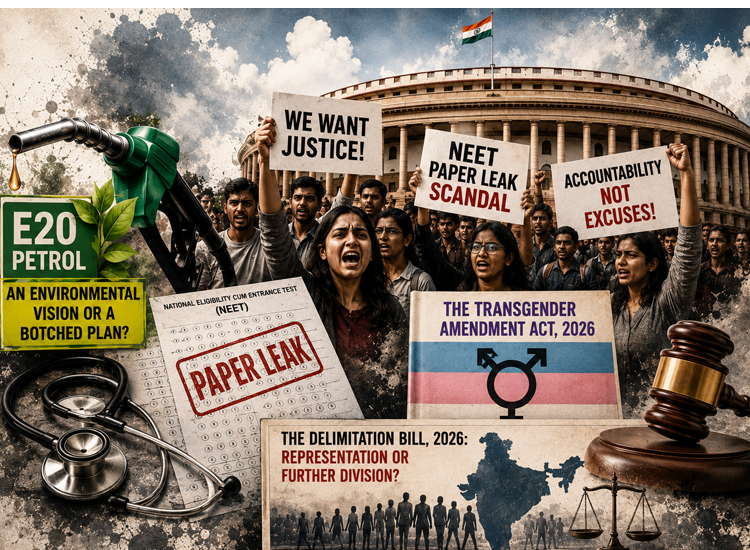
Today, however, the political landscape of the country appears to be changing. Recent policy reforms and poor public opinion of them have led to the fall from grace of what was once the most popular political party in the world's largest democracy. Whether it's concerns over E20 petrol, the NEET paper leak scandal, or the controversial Transgender Amendment Act, people are now noticing a pattern of highly rushed and poorly implemented reforms.
The government that once thrived on public trust may now find rebuilding it to be its greatest political challenge.
E20 Petrol: An Environmental Vision or a Botched Plan?
The government's plan to roll out 20% ethanol-blended petrol was intended to reduce India's dependence on imported crude oil and lower carbon emissions. On paper, the objectives are commendable. In practice, however, the burden of adaptation has fallen primarily on citizens.
Millions of owners of older vehicles have questioned whether their vehicles are compatible with the fuel, while others have expressed concerns over lower fuel efficiency and higher maintenance costs.
Environmentalists have pointed out that increasing ethanol production would require greater cultivation of water-intensive crops such as sugarcane. In a country facing recurring water shortages, the consequences could be severe. People living near ethanol-producing factories have also complained about air and water pollution, unpleasant odours, and inadequate regulation of industrial waste.
Instead of addressing these concerns and reassuring the public through greater transparency, the government has appeared keen to move ahead with the policy.
The NEET Paper Leak Scandal
Perhaps
no other recent controversy has shaken public trust more than the NEET paper leak.
For millions of students, this examination represents years of preparation, financial struggle, and personal sacrifice. They appear for the exam in the hope of at least a fair and just system that rewards merit and gives them a chance at a brighter future.
When allegations emerged that networks of miscreants had illegally distributed the examination paper to those who could afford it, public confidence in the system suffered a major blow.
The government's handling of the leak drew widespread criticism, with many believing that its response was too little, too late. Students took to the streets demanding a re-examination and the strictest possible action against those responsible.
People were left wondering whether a government that cannot guarantee fairness in a national-level examination is even capable of governing a nation.
The Transgender Amendment Act, 2026
The government stated that the amendment would bring greater clarity and prevent the misuse of welfare schemes. Under its provisions, transgender individuals would have to undergo medical verification in order to obtain legal recognition.
For many human rights activists, this requirement was seen as stripping away the right to self-identify one's gender, a right recognized by the Supreme Court in the 2014 NALSA judgment. Rather than uplifting a marginalized community, subjecting them to medical scrutiny was viewed as a significant step backwards.
The bill was also criticized for being passed without consulting the transgender community, despite directly affecting their lives and legal rights.
The Delimitation Bill, 2026: Representation or Further Division?
The bill was presented by the government as an electoral reform aimed at redrawing constituencies based on population and expanding the Lok Sabha.
The government argued that this would ensure fair representation and facilitate the implementation of women's reservation in Parliament.
However, the strongest opposition came from the southern states. Critics argued that the proposal would reduce their influence in Parliament despite decades of successful population control and significant investments in education, healthcare, and human welfare.
Another contentious aspect of the bill was the proposal to carry out delimitation on the basis of the 2011 Census. The Opposition questioned why the government was pressing ahead instead of waiting for the updated 2026 Census data.
The strongest criticism, however, was directed at the government's decision to link delimitation with women's reservation. Opposition parties accused the government of forcing them to choose between supporting women's empowerment and accepting a controversial redistribution of parliamentary seats.
As a result, the Delimitation Bill became the first bill introduced by the Modi Government since 2014 to fail to secure a two-thirds majority in the Lok Sabha, exposing the limits of the BJP-led NDA's parliamentary majority.
Conclusion
All governments experience successes and setbacks. What ultimately determines public support is not whether mistakes are made, but how they are acknowledged and corrected.
As more young people become politically engaged and informed, they increasingly expect transparency, consultation, and accountability from those they elect.
If the government hopes to regain the trust of the people, it will have to begin a genuine dialogue with citizens rather than making decisions unilaterally.
After all, democracy is the government of the people, by the people, and for the people - and it always shall be.
